The importance of intensity level
Throughout your bariatric journey, it is important to understand the level of intensity you feel when you engage in physical activity. Your intensity level gives you an indication of how hard your heart is working and lets you know if you are ready to progress in your activity or whether you should dial it back a bit.
Everyone is different, and intensity varies from person to person, depending on, among other things, previous exercise experience and fitness level. Both prior to and immediately following your bariatric surgery, the intensity of your physical activity will be relatively low, as you are building up your basic level of physical condition.
Measure your own intensity level
Take notice of and monitor your perceived exertion. Perceived exertion is how hard you feel like your body is working. It’s based on the physical sensations you experience during physical activity, including increased heart rate, increased respiration or breathing rate, increased sweating and muscle fatigue. Although this is a subjective measure, your perceived exertion provides a fairly good estimate of your actual heart rate during exercise.
How do you feel?
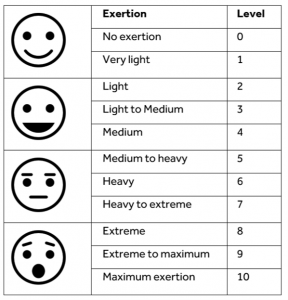
There are several levels of exertion you can use to estimate your heart rate –very light, medium, heavy and maximum exertion. You can rate your exertion on a scale from 0 to 10, where 0 means ‘no exertion at all’ and 10 means ‘maximum exertion’. This will give you a good idea of your intensity level, and you can use this information to speed up or slow down your movements to stay within your desired range.
For example, if you’re sitting on the edge of your bed in the morning and experiencing no exertion, you are at level 0. If you need to run full speed to catch the bus and find yourself out of breath and unable to talk once you reach your seat, you may be at level 9.
A tool for progressing your activity
Try to assess your level of exertion as honestly as possible. Do not concern yourself with factors such as leg pain or shortness of breath, but rather focus on your overall feeling of exertion. And, as always, don’t compare yourself to others. Use your Borg rating to either progress or slow down your activity.
The exertion challenges
Try this exertion experiment. Sit and stand on your chair 5 times as fast as possible. Before and after doing the exercise, note the intensity of exertion level you feel.
Preparation:
- Place a chair against the wall.
- Sit on the edge of the chair.
- Cross your arms over your chest.
- Breathe normally and pay attention to your breathing, focus on how are you feeling at this moment, how fast you are breathing and how fast your heart is beating: What is your level of exertion?
Execution:
- Perform 5 sit-to-stand repetitions as rapidly as possible.
Endpoint:
- After 5 repetitions, stay sitting.
- Close your eyes and focus again on your level of exertion. What happened in your body after this action? How is your breathing?
- Look at the exertion scale. What is your level of intensity at this moment?